I graduated from the Indian Institute of Science (IISc) on July 10, 2026, at our convocation. Officially speaking, this means I completed eight semesters’ worth of coursework with satisfactory performance. I did complete, but definitely not just my credit requirements. It would be quite disappointing if that is all I completed in the nearly 45 months I spent with IISc!
But one can complete only what they started. I do not precisely remember what I wanted to do when I joined IISc—but I do remember that it was a romantic idea, something to do with learning a lot, something to do with research, something to do with working on big ideas. It was a difficult romance to maintain, particularly around deadlines and exams when we would all question our teenage decision to join this institute instead of taking on mushroom farming1. By the time we were only a few months away from the end, many of us had lost track of our once-so-captivating relationships with our romantic ideas, and all we could wish for was to finish our degrees and move on. IISc seemed to have become a chore, a matter of staying afloat as we kept up with a few letters and numbers, a matter of dragging our feet through the constant whining and griping of ourselves and our peers. It would have been easy to move on from buildings and numbers and our many gripes, but how could I so easily move on from that romance—especially when it barely seems fulfilled! Did I learn enough, become a researcher, or work on anything big? And what about all the other things that I didn’t even know I wanted until I was here?
During my final, fleeting glance at IISc, I realized that this romance had not come to an end. While I embraced the realization that I would never again feel so much like a student taken care of by this collegetown in the middle of a metropolis, I understood that my time at IISc had taught me what this romance was truly all about. This post is going to be about that.
Asking questions
We all know that we are not taught to ask questions in school. It might even be the case that sometimes we are taught not to ask questions. I knew from all over the internet that asking questions is important. People on the internet called it critical thinking, and I thought it was pretty simple. Of course my thinking is critical! I even asked a few questions in school, and probably more questions than most of my peers. But IISc changed my understanding of what it means to ask questions.
Here I had the chance to be friends with people who could question essentially anything. I would almost wait for them to ask a question in class, because every time they did, I would either find that there was something I did not think I should know, or that there was something I thought I knew but actually did not. Not only could these people ask questions, they could pare down other people’s questions, they could make questions more general or more specific, they could branch questions out or merge them together, and they could even rephrase questions so that they answered themselves! My time at IISc has convinced me that asking questions is a way of life—it transcends the classroom and is a way to both understand and experience the world at large.
Answering questions
Asking questions is only one side of the battle. And when the questions are hard, there might be no easy answers—not easy even for the professors! People usually get nervous when they don’t immediately know how to answer a question. Sometimes they even get irritated and brush it off altogether. Or worse, they answer incorrectly. However, whenever posed with a question, professors in IISc have consistently proven that they are genuinely curious and are interested in the students’ and their own understanding of the topic. Professors listen to questions intently, confirm whether they understand the question, and then think carefully before answering. Some professors even take what others might consider an awkwardly long moment of silence, deep in their thoughts, before speaking again. And they don’t just answer but also walk their audience through the process to get to that answer. Most importantly, they do not hesitate to admit when they do not know. It does not matter how senior or accomplished they may be—if they cannot answer confidently, they will not answer.
I often heard the phrase stupid question in school, and I admit that some questions indeed sound stupid to me. When someone asks such a question in class, I do not even know where I would begin to answer it or what specifically I would say to clear their confusion. Often I wouldn’t be able to even understand what their confusion must have been. But while I am thinking of all this, the professor comes up with an answer that clears the confusion—it is almost a magical experience to see this happen. It turns out that answering questions is less of a matter of knowledge and more of a matter of curiosity, patience, and humility.
Being disliked
People usually don’t like to be disliked. Most people hate it more than they hate to disagree with others. I therefore find myself looking with awe at the few people who are not afraid to be disliked if that means they can be honest and be their true selves. And I believe I have been quite fortunate to have been close friends with a few of these people at IISc. It has been with these people that I have had some of the most meaningful and unpretentious conversations of my life. And though I am frankly envious of their honesty and courage, I have come to learn a bit from them—to speak my mind, to stand against the wrong, to appreciate the right, to be disliked if necessary.
Working hard
Everyone works hard at IISc. In some way, there is no other way to keep up with everything inside and outside the classroom. While it’s almost as if most of us are made to work hard by the system, I have friends at IISc who, driven by nothing but passion, can work for worryingly long hours without for once thinking of anything besides what they are doing. For instance, one friend of mine can absolutely not accept that he is unable to understand a concept or solve a problem, and if faced with such a situation, he will scour through every book, paper, or lecture that he can find on the internet, not resting until he can come out of his room and explain the concept confidently to anyone who will listen2. I have friends who have, with sheer tenacity, mastered a skill that they had no prior experience with, succeeded in a discipline different altogether from their own, or bounced back from repeated failures. What do you do when you are surrounded by such dedicated people? More often than not, you are inspired to work hard too.
Not working too hard
Sometimes you want to, and sometimes you need to, leave your desk and go for a walk, take a coffee break, do a bit of sport, play some foosball, or watch a movie. It is unlikely that you will always be able to pull yourself to do any of these, but friends can make it much easier. You just need someone to remind you that if you don’t slow down, you crazy child, you’re gonna kick off before you even get halfway through, and if you happen to insist too much, someone to assure you that it’s all right, you can afford to lose a day or two3. And before you realize it, you too become that friend for someone else. It sounds funny when I insist to freshmen that they must learn to relax, but everyone who has been through IISc can testify to it4.
Close to every other student in my class has an exciting story to tell about how they made it to IISc, sometimes arguing with their parents, fighting their circumstances, or defying extraordinary odds. And all of that for their romantic idea of pursuing science, pushing its frontiers with their own hands, and becoming great scientists. What did IISc do to these romantic ideas? At least for me, it enriched the romance with a deeper understanding of what I really want—not just to be a scientist, but to be a person who can ask questions, create a path toward answers, fearlessly speak their mind, work hard, and yet not work too hard to forget the point of it all. I have graduated, completing possibly just my credit requirements, but hopefully starting the next chapter of my romance with a lot more insight.
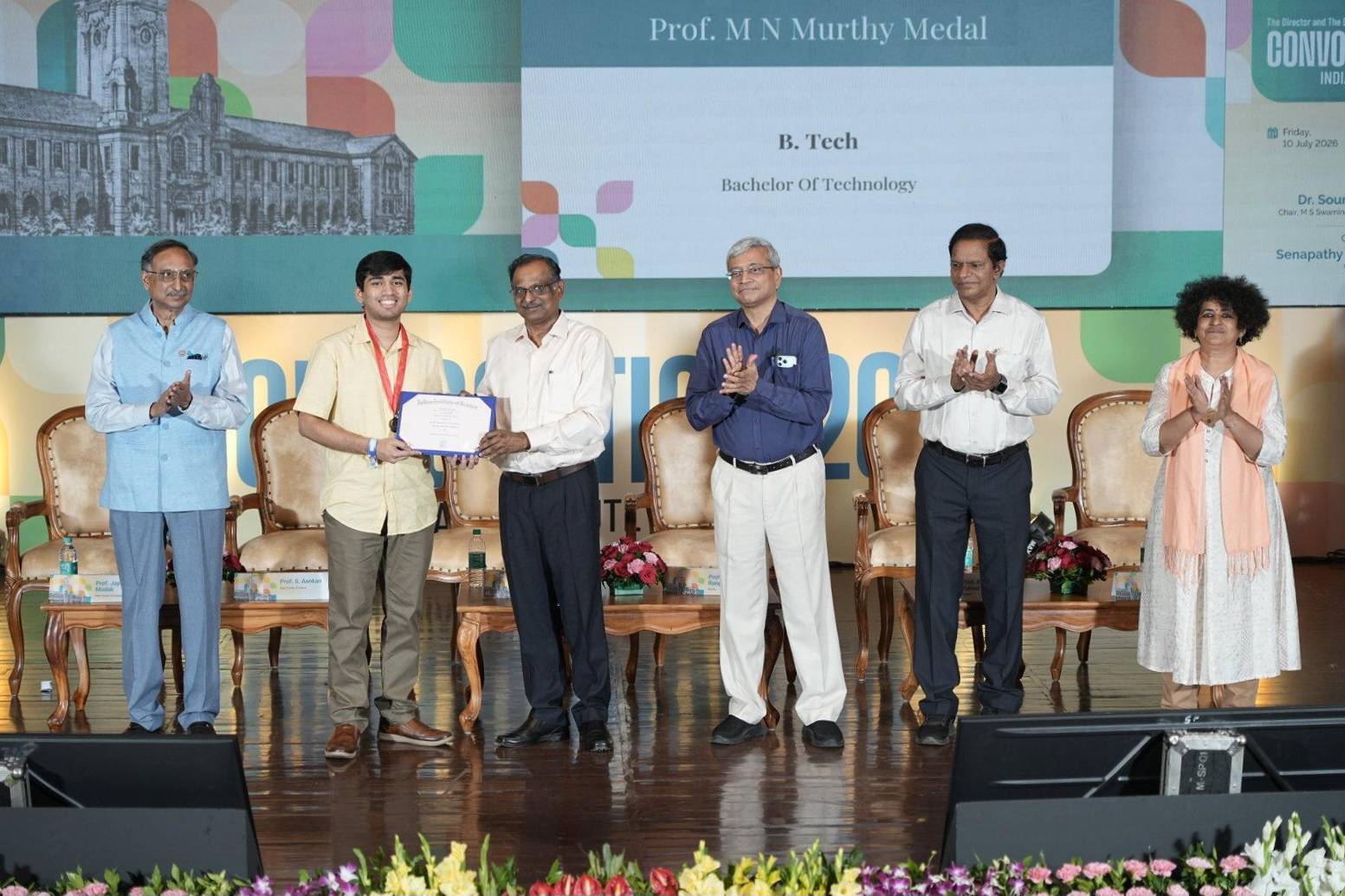
Photograph from the convocation while receiving the Prof. M N Murthy Medal.
-
I honestly don’t remember how this thought came about, but I am certain that it was mushroom farming with friends that was more appealing than mushrooms or farming alone. ↩
-
Thankfully there is always someone to listen to even the most obscure of topics. ↩
-
However, there is no guarantee on how informed the assurance is! And yes, I love Vienna. I credit this blog for introducing me to this beautiful song back in 2021. ↩
-
I, in fact, have some faint memory of being told the same by seniors during our freshman orientation, but I thought at the time that it was not something I would need to worry about. Well, the cycle continues… ↩