Since graduating once was not enough, I am starting again as a student at the University of Pennsylvania, where I will pursue a PhD in Computer and Information Science. After speaking to countless1 people, both students and professors, in the early part of this year to decide where to go for my PhD, and spending my summer watching countless2 movies, I am finally here and hopefully ready to start! While it was reassuring that I had the opportunity to gain enough experience during my undergrad to understand the comic (see below) printed on the first page of our PhD orientation packet, there is indeed a lingering sense of excitement and nervousness about grad school. Of course, grad students have more independence and time to focus on research, but they are also treated as grown-ups who need to take care of all other aspects of their lives and careers on their own.

PhD Comics: How Grad School Is Just Like Kindergarten.
Why?
Honestly, just because it sounds fun3! When I was in high school4, I really used to enjoy coding5 because it let me create things that people could interact with and say, “woah, that’s cool!” I began participating in entrepreneurship competitions and programs with my software projects and saw many of the processes that I would later encounter in research—problem identification, understanding existing solutions, formulating a hypothesis, prototyping, testing, iterating, and marketing the work. However, at some point, I began to feel that the projects I was working on were not intellectually fulfilling and their success6 was related to several factors other than their technical aspects. By the time I started my undergrad, I had decided to pursue research7, and my experiences during my undergrad only strengthened this decision. I touch upon a few of these experiences in the next section.
How?
I think the most important factor is experience, about which I have talked a bit in my advice to juniors. Working closely with helpful and encouraging mentors and colleagues has been invaluable in helping me learn about the research process, decide whether I want to do more of it, and prepare for grad school to actually do more of it. For instance, my internship at UIUC taught me about the open-ended nature of research, working with and within deadlines, and the process of writing and publishing research, among many other things. Very importantly, it gave me a sneak peek into the lives of graduate students, as they would juggle their different responsibilities, experiment and fail, present their progress to their advisors, and lead their own projects. At the end of it all, I thought it was kind of hard, but also kind of fun, and I could maybe do it too. I got the chance to lead a project of my own, from conceptualization to writing the paper, while working with collaborators from UVA. It was indeed challenging, but also satisfying to see the project through rebuttals and revisions, until it was finally accepted at ASE 2025. This was the first big conference I attended, and also the first time I presented my work to a large audience. Finally, my time at Microsoft helped me see the gap between theory and practice, and what software engineering means in the real world. I believe all of these elements have been pivotal in my journey to grad school, and I am grateful to all the mentors and colleagues who have supported me along the way.
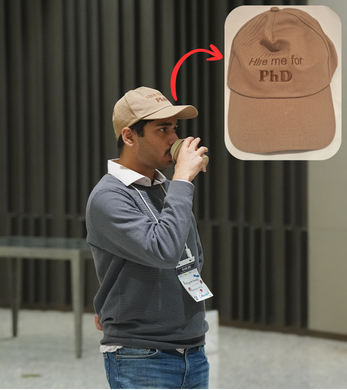
Me having another cup of coffee at ASE, as if I didn't already have enough, while wearing a cap indicating my desperation to find a graduate position. The cap did attract a healthy amount of laughs during the five days I wore it at the conference.
The elephant in the room
I work in software engineering, and I can’t ignore the impact of AI on the problems that I have worked on and the kind of research I would like to do in the future. My stint at Microsoft overlapped with rapid improvements in AI-agents for coding, and I could observe in real time as the way we thought about problems and our problem-solving methodology changed. The question of what kind of research one can or should do is not for me to answer, but I do have two axes along which I measure any given problem. The first is impact, i.e., whether a problem has a noticeable effect on the world and whether there is demand for a solution. The second is fulfillment, i.e., whether the technical challenges involved in solving the problem are intellectually stimulating. Naturally, AI has the potential to solve a lot of problems with high impact, but solving the problem itself becomes less fulfilling as AI might do most of the heavy lifting. This is not to say that certain problems are trivial or uninteresting. I am also not advocating for throwing away AI. Problems that can be solved with AI should indeed be, though they might not be the most fulfilling problems to work on. The question that I have to ask myself is about what kind of problems I want to work on. Here is a little visualization of my dilemma.
| Low Impact | High Impact | |
|---|---|---|
| Low Fulfillment | Why bother? | I want to do it but I don’t know if I will learn anything. |
| High Fulfillment | I will learn a lot but nobody will care. | Sweet! |
Many other factors need to be considered too. For example, certain problems may currently be in the bottom-right quadrant, but they might move to the top-right as AI improves, possibly before I can finish my PhD! It may also be difficult to work on problems in the top-right quadrant because one may be competing with other labs with manifold the resources. And everything is so rapid and so uncertain that nobody really knows where things will go. I was deeply bothered by this uncertainty, fearing that either I would not enjoy what I do or that I would not be able to make any meaningful contribution. The latter is up to other people’s judgment, but I can at least try to ensure the former. It is a bit eerie that the following lyrics from Forest8 fit the situation so well.
I scream, you scream
We all scream, ‘cause we’re terrified
Of what’s around the corner
We stay in place
‘Cause we don’t wanna lose our lives
So let’s think of something better
And later on the point I am trying to make becomes even more explicit.
My brain has given up, white flags are hoisted
I took some food for thought, it might be poisoned
The stomach in my brain throws up onto the page
Does it bother anyone else that someone else has your name?
Indeed it is bothersome to imagine that someone else—or worse, something else, like Claude or GPT9—could take my name, i.e., “researcher” or “software engineer”. The only way to avoid this would be to take on a name that is more than that.
What all of this means for this blog
Well, nothing much. I will continue to write10 about my experiences, possibly with a bit more focus on technical topics and research. However, this blog will continue to be free style and candid as it has been.
-
I can count somewhere between 60 and 65 people, talking to many of them multiple times. I am grateful to everyone who shared their experiences and advice with me. ↩
-
I genuinely lost count, so this is truly countless. ↩
-
I believe that is quite a privilege. Certainly everyone I know who is pursuing a PhD, or has finished one, started it for their passion for research. But some of these people also had other reasons which became tipping points for them to enter grad school—for instance, to get away from their conservative family, or to escape civil war in their country. ↩
-
Yes, I am starting a bit on the cliché personal note. And indeed this is adapted from part of my personal statement for my PhD applications. ↩
-
Now I enjoy watching Claude code for me. ↩
-
Or failure, for the most part. ↩
-
Though I had no idea what kind of research I wanted to do, or what even research is about, this was one of the reasons I joined the Indian Institute of Science. ↩
-
By Twenty One Pilots, obviously. ↩
-
Trying to not accidentally anthropomorphize AI. ↩
-
Let us hope I am at least as consistent as, or in other words, no more inconsistent than, I was during my undergrad. ↩